
 +34 68 911 88 69
 +382 69 704 986

Caribbean citizenship by investment
A Caribbean passport offers a fast and affordable path to second citizenship through investment, opening up new opportunities for travel, business, and tax planning.
Are you interested in applying for a residence permit or dual citizenship?
Get a personalized consultation and a free assessment of your immigration options from a MIRSATORI specialist
Submit a request and get advice from an expert

Caribbean citizenship vs. residency by investment: key differences
Citizenship and residency are two fundamentally different statuses that grant foreign nationals distinct rights and opportunities.
| Criterion | Caribbean citizenship by investment | Residence permit |
|---|---|---|
| Type of status | Full citizenship | Temporary residence status |
| Validity | Lifetime | Requires periodic renewal |
| Time to citizenship | 3–6 months | 5–10 years |
| Status for the whole family | Yes, can generally be included | Available in some programs |
| Status passed on to descendants | Yes | No |
| Travel freedom | Visa-free or visa-on-arrival access to 136+ destinations, depending on the Caribbean passport | Generally determined by the applicant’s citizenship |
| Residence requirement after approval | Usually none | Generally required |
| Rights | The right to work, voting, and land ownership rights | More limited rights; the right to work depends on the type of permit |
| Primary purpose | Greater global mobility, business opportunities, and a “Plan B” | Living in the specific country |
Caribbean nations do not offer residence permits in exchange for investment. However, compared with “golden visa” schemes, their citizenship-by-investment (CBI) programs are often more financially accessible. The investment threshold for a residence permit typically starts at EUR 250,000 (approximately USD 290,000), but in Dominica, for example, citizenship can be obtained directly for USD 200,000.
In 2024, Caribbean nations adopted a joint memorandum stipulating that the minimum investment amount for CBI participation is USD 200,000. Nevertheless, the 5 programs differ in terms of entry thresholds, processing times, and investment options.
| Country | Processing time, months | Available investment options | Minimum investment, USD |
|---|---|---|---|
| Grenada | 3–4 | Fund contribution, real estate | 235,000 |
| Antigua and Barbuda | 3–6 | Fund contribution, real estate, business | 230,000 |
| Saint Lucia | 3 | Fund contribution, real estate, government bonds | 240,000 |
| Dominica | 3–6 | Fund contribution, real estate | 200,000 |
| St Kitts and Nevis | 4–6 | Fund contribution, public benefit projects, real estate | 250,000 |

Countries offering Caribbean citizenship by investment
As of 2026, 5 Caribbean nations offer citizenship-by-investment programs:
- Saint Kitts and Nevis;
- Grenada;
- Antigua and Barbuda;
- Saint Lucia;
- Dominica.
For these small island nations, Citizenship by Investment (CBI) programs serve as strategic development tools. These programs attract hundreds of millions of dollars annually without burdening the local population with taxes. This represents “clean” capital that flows directly into the national budget.
Funds from government pools, in which investors make contributions, are used to build modern hospitals, schools, and roads, as well as to facilitate the transition to green energy. Since the Caribbean region is prone to hurricanes, these funds also serve as a financial safety net, enabling countries to quickly recover from natural disasters without relying on external aid. Investments in hotels transform the islands into world-class luxury resorts and create thousands of jobs for local residents.
Essentially, obtaining a Caribbean passport through investment is a mutually beneficial partnership. Investors gain citizenship, travel freedom, and other opportunities, while countries secure resources for their own development and prosperity.
Dominica
The entry threshold for Dominica’s citizenship-by-investment program is USD 200,000. You may choose one of 2 options:
- A non-refundable contribution to the Economic Diversification Fund (EDF)
These funds are allocated to national projects in sectors such as education, healthcare, sports, tourism, agriculture, and information technology. - Real estate investment
Properties must be purchased within government-approved projects, such as resorts operated by global chains or exclusive residential complexes. The asset may be sold after 3 years—or after 5 years if the buyer is a new participant in the citizenship program.
The amount for investments in the state fund depends on the number of people included in the application:
| Amount, USD | Applicants included |
|---|---|
| 200,000 | Main applicant |
| 250,000 | Main applicant + up to 3 family members |
| 25,000 | Each additional family member under 18 |
| 40,000 | Each additional family member aged 18 or older |
If the investor chooses the real estate option, the property value threshold is unaffected by the family’s composition. However, the government fee amount differs:
| Government fee, USD | Applicant included |
|---|---|
| 75,000 | Main applicant |
| 100,000 | Main applicant + up to 3 family members |
| 25,000 | Each additional family member under 18 |
| 40,000 | Each additional family member aged 18 or older |
In any case, there are associated fees:
- Application processing: USD 1,000 per application;
- Due diligence: USD 7,500 for the investor and USD 4,000 for each additional family member;
- Issuance of the naturalization certificate: USD 500 per person;
- Interview: USD 1,000.
The entire process, from compiling the dossier to receiving the new documents, takes 3–6 months. All program participants over the age of 16 must complete a personal interview conducted online. The oath-taking procedure is also carried out remotely in the presence of an authorized notary or other official.
 Dominica citizenship by investment
- Second citizenship for the family
- Investment refundable in 3–5 years
- Fully remote application process

Antigua and Barbuda
Antigua and Barbuda offers citizenship through one of 4 options:
- Make a charitable contribution to the National Development Fund. The contribution amount is USD 230,000 for a family of up to 4 people.
- Invest in the University of the West Indies (UWI) Fund. The investment amount is USD 260,000. This option is exclusively for large families; the minimum group size per application is 6 people. One family member is entitled to a year of free tuition at UWI.
- Purchase real estate. You must invest at least USD 300,000 in a government-approved project. The property must be held for at least 5 years after purchase. To retain citizenship status after selling the property, one must purchase a share in another approved project.
- Invest in a business. The program offers 2 forms of participation. As an individual investor, you must invest a minimum of USD 1,500,000 in an existing or new, government-approved business. There is also a group investment option, in which several individuals can pool their funds to invest in a single, large-scale project valued at least at USD 5,000,000. Each individual participant must contribute a minimum of USD 400,000 in this case.
An application processing fee applies in all cases except for investments in the university fund:
- USD 10,000 for the main applicant;
- USD 20,000 for applications involving up to 4 people;
- For families of 5 or more people: USD 20,000 plus an additional USD 10,000 for each person starting from the 5th person.
For the University of the West Indies option, the government processing fee is USD 10,000 per dependent, starting with the 6th.
All applicants over the age of 18 must take an oath. This can be done at the embassy or consulate of the country in question. Citizenship processing for Antigua and Barbuda takes between 3 and 6 months. The country has a physical presence requirement; investors must spend at least 5 days on the islands within the first 5 years of obtaining citizenship. Investors typically combine this requirement with a short vacation.
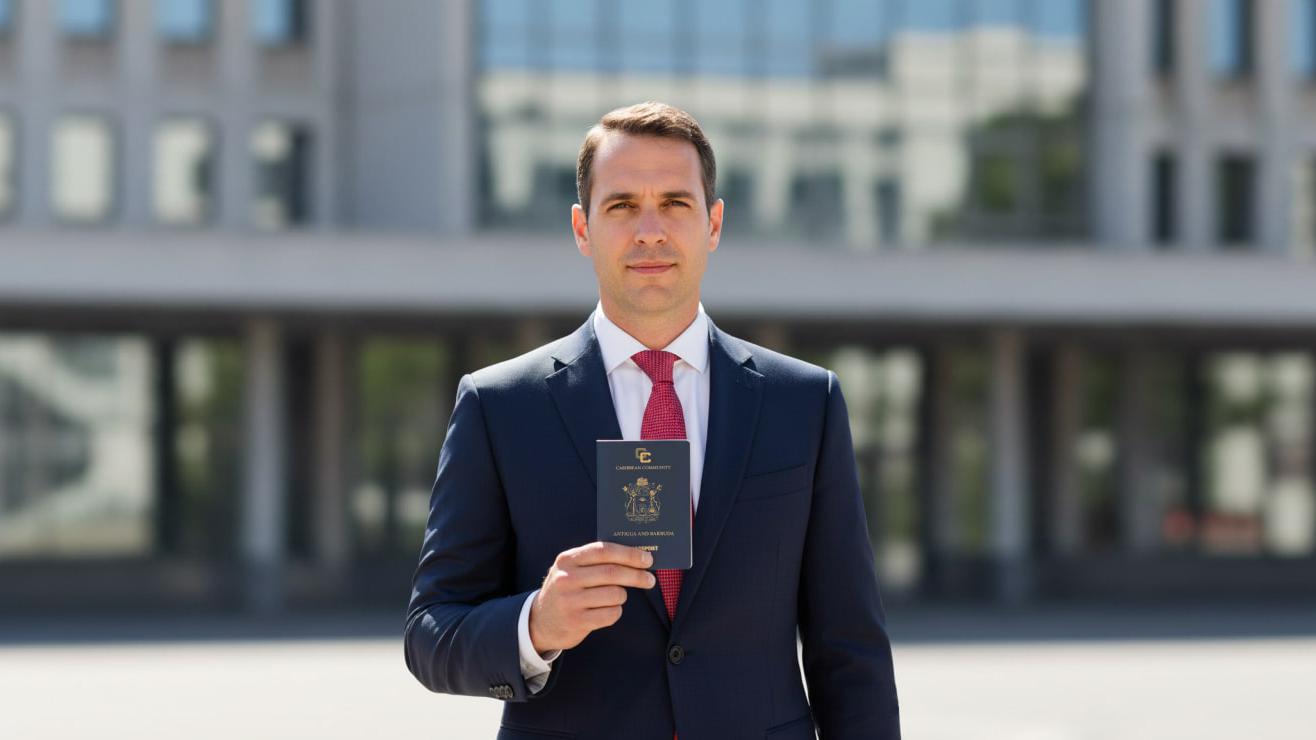 Antigua and Barbuda citizenship by investment
- Second passport for the family
- No language requirement
- Investment refundable after 5 years

Grenada
Grenada’s citizenship-by-investment program has 2 options:
- Investment in the National Transformation Fund (NTF). A contribution of at least USD 235,000 is required for a single applicant or a family of up to 4 people. An additional fee ranging from USD 25,000 to 50,000 applies for each additional family member, except for siblings, for whom the fee is USD 75,000 each;
- Real estate investment. Investors can purchase a share in an approved project, such as a hotel or villa, for a minimum of USD 270,000. Purchasing an entire property requires a minimum investment of USD 350,000. The property may be sold after 5 years. This option incurs an additional government fee of USD 50,000.
There is also an application fee of USD 1,500 per person. Due diligence checks cost USD 5,000 per person, and the application processing fee is USD 1,500 per person. An additional USD 1,000 per person is charged for the interview.
Processing a Grenadian citizenship application takes about 60 business days (about 3–4 months). Since 2023, all applicants over 17 have been required to complete a mandatory video interview.
 Grenada citizenship by investment
- Second passport for the investor’s family
- No language requirement
- Investment return after 5 years
Saint Lucia
Saint Lucia offers investors 4 investment options:
- Investment in a local enterprise
Individual investment in a business project requires a minimum of USD 3,500,000. Joint investments totaling at least USD 6 million are also available, provided each participant contributes at least USD 1 million. In both cases, a government fee of USD 50,000 applies. Another option is to invest in infrastructure projects, starting at USD 250,000. - Investment in the National Economic Fund (NEF)
The minimum investment is USD 240,000 for a single applicant or a family of up to 4 people. An additional fee of USD 5,000 to USD 35,000 applies to each additional dependent. - Purchase of government bonds
The purchase amount is fixed at USD 300,000, regardless of family size. This is a “refundable” option: You purchase non-interest-bearing government bonds. After 5 years, the government repurchases the bonds at face value. You only lose the government fee (USD 50,000), while the principal investment is returned. - Real estate purchase
Purchasing a share in an approved project requires a minimum investment of USD 300,000. The holding period is at least 5 years. Government fees depend on family composition and range from USD 5,000 to USD 45,000.
Application processing fees are USD 2,000 for the main applicant and USD 1,000 for each additional applicant. Due diligence fees are USD 8,000 and USD 5,000, respectively.
All applicants over the age of 16 are required to complete a mandatory online interview. Saint Lucia citizenship is granted in approximately 3 months.

How much does a Caribbean passport cost?
The cost comprises not only the principal investment amount, but also government fees, interview and due diligence charges, application processing fees, and other expenses. The table below outlines the cost of a Caribbean passport for a single investor across all 5 countries:
| Country | Minimum contribution, USD | Additional citizenship costs, USD | Total cost, USD |
|---|---|---|---|
| Dominica | 200,000 | 10,000 | 210,000 |
| Grenada | 235,000 | 9,000 | 244,000 |
| Antigua and Barbuda | 230,000 | 10,000 | 240,000 |
| Saint Lucia | 240,000 | 10,000 | 250,000 |
| St Kitts and Nevis | 250,000 | 10,000 | 260,000 |
However, the total cost varies significantly depending on the investment option chosen and the number of family members included in the application. Mirsatori specialists are available to review your case and calculate the cost of participating in Caribbean investment programs.
Obtaining Caribbean citizenship remotely
Citizenship in all 5 of the aforementioned countries can be obtained entirely remotely through licensed agents. You do not need to travel to the islands to submit documents or collect your passport. The process is standardized across all countries and typically consists of 5 stages:
- Selecting an agent and preparation
First, you must contact an agent licensed by the authorities of your chosen country. The agent will explain the program terms in detail, calculate the total cost of participation, and provide a list of required documents. The agent’s legal team will also conduct an initial internal review to minimize the risk of rejection. Work proceeds under a signed agreement. - Submitting documents and due diligence
The agent helps compile the application dossier correctly and submits it to the citizenship department. The country’s competent authorities then conduct comprehensive due diligence. At this stage, you pay the security screening and processing fees. Almost all of these countries require an online interview, so travel is not necessary. - Preliminary approval
You will receive an official letter confirming your approval. Only then do you make the investment. The agent submits proof of payment to the citizenship department. - Taking an oath of allegiance
This step is not mandatory in every country, but it is required in Dominica and Antigua and Barbuda. The process is usually conducted via video call. - Obtaining new documents
The government issues a certificate of citizenship. Based on this document, the agent will apply for your passport. Your completed identity document and certificate of naturalization are sent to your agent, who forwards them to you.

Mirsatori specializes in supporting investment-based citizenship programs. We will help you prepare the necessary documents properly and guide you through every stage of obtaining a second passport.
Can investors keep their original passport?
All 5 Caribbean nations that offer citizenship-by-investment programs officially permit dual citizenship. You are not required to renounce your original passport. Furthermore, the process of obtaining Caribbean citizenship is confidential, and the authorities will not notify your country of origin that you have acquired a new passport. However, you should verify whether your home country permits dual citizenship.
Risks and downsides of a Caribbean passport
Although a Caribbean passport remains a powerful tool in 2026, it comes with certain nuances.
For example, some options require non-refundable investments, specifically donations to government funds. Therefore, if your goal is capital recovery, you should choose your program carefully.
If you choose to invest in Antigua and Barbuda, pay close attention to residency requirements. Failure to spend at least 5 days in the country during the first 5 years could result in the revocation of your status.
As of January 2026, the U.S. has imposed temporary restrictions on the issuance of immigrant visas to citizens of 75 countries, including Caribbean nations. Additionally, obtaining a U.S. tourist visa now requires posting a bond ranging from USD 5,000 to USD 15,000.
Since 2026, banks worldwide, particularly in the EU and the US, have been automatically flagging accounts opened using Caribbean passports as “high-risk.” You may face more frequent inquiries about the source of your funds and be required to provide proof of a genuine connection to the islands, such as utility bills or proof of a residential address.
Caribbean citizenship and taxes
The Caribbean remains one of the world’s most attractive tax havens for investors. However, it is important to distinguish between citizenship and tax residency status. Having a passport does not make you a taxpayer in the islands, but it does allow you to optimize your taxes.
According to standard rules, becoming a tax resident requires spending more than 183 days a year in the country. Therefore, if an investor obtains citizenship but does not relocate, they are not required to pay taxes under local regulations.
A key advantage of the Caribbean region is its territorial tax system. Under this system, income earned by residents and non-residents is only taxed if it is generated within the country’s territory. Furthermore, certain taxes, such as those on capital gains, inheritance, and gifts, are completely absent in these jurisdictions.
| Country | Tax on worldwide income, % | Wealth/inheritance/gifttax, % | Capital gains tax, % |
|---|---|---|---|
| St Kitts and Nevis | 0 | 0 | 0 |
| Antigua and Barbuda | 0 | 0 | 0 |
| Dominica | 15–35 (residents only) | 0 | 0 |
| Grenada | 10–28 (Grenada-source income only) | 0 | 0 |
| Saint Lucia | 0–30 (local-source income only) | 0 | 0 |
Benefits of a Caribbean passport
A Caribbean passport allows you to travel to over 136 countries worldwide without needing a visa in advance. In the event of a crisis, you and your family will always have a country that is obligated to accept and protect you. Citizenship is hereditary and extends to your children and grandchildren. As citizens of the Commonwealth of Nations, your children can gain admission to British universities under favorable terms.
Having a second Caribbean passport allows you to open bank accounts in Europe, the UAE, and other jurisdictions, even if you previously had difficulty doing so. You can hold assets globally and benefit from the tax advantages of your second country of citizenship. Business owners can streamline international operations by utilizing the offshore zones of Caribbean nations.
Obtaining a Caribbean passport does not require you to renounce your current citizenship. This means you can maintain ties to your home country while enjoying the benefits of both passports.
The lawyers at Mirsatori are ready to help you secure all the advantages of a second passport in the shortest possible time. Submit a request, and we will contact you to schedule a personal consultation.



News, tips, and exclusive insights — all on our channels. Pick the platform you prefer:


Fill out the form to schedule a meeting in the office or online

 +971 58 94 43 591