 +34 68 911 88 69
 +382 69 704 986
Consulting services for Web 3.0 project licensing:
- VASP licensing in the UAE, Switzerland, and the Cayman Islands
- Legal structuring of management entities for DAOs
- Token classification under securities law analysis
Join us on September 24, 2026, at Beyond Borders in Lagos.

Unlock your options — consult with an expert today
99% of Web3 projects launch without a proper legal structure. The result: bank account freezes, exchange delistings, regulatory fines, and personal liability for founders.
Mirsatori builds long-term legal architecture for DAOs, DeFi protocols, and NFT platforms. We help clients select the right jurisdiction, obtain VASP licenses, structure tokens, and ensure compliance in target jurisdictions — from legal analysis through operational launch.

Digital Business Readiness: Prepare your business for the market

Submit an application to discuss the requirements for your business model, the applicable 2026 regulatory framework, and your projected launch budget
Unlock your options — consult with an expert today
Legal analysis and jurisdiction selection
We analyze the business model and protocol functionality, identify the optimal jurisdiction with regard to the regulatory framework, tax treatment, and capital requirements, and review project documentation for regulatory risk exposure.
Corporate structuring
We design a multi-layer structure comprising an operating company, token issuer, intellectual property holding entity, and legal wrapper for the DAO. This ensures liability segregation and asset protection.
Licensing
We provide consulting services regarding the acquisition of VASP, payment, and asset management licenses in the UAE, Switzerland, the Cayman Islands, and Wyoming (USA). Comprehensive support: from preparing the application to receiving the regulatory decision.
Token classification and securities law analysis
We determine whether a token falls within securities regulation in the target jurisdictions. We develop a compliance strategy or structure the token to minimize regulatory risk.
AML/KYC implementation
We develop AML and customer identification policies in line with FATF standards, select service providers, implement transaction monitoring, and establish reporting procedures.
DAO legal structuring
We establish legal wrappers, including Foundations, LLCs, Associations, and Cayman Foundation Companies / Wyoming DAO LLC-type structures (as applicable), in jurisdictions such as the Cayman Islands, Wyoming, Switzerland, and Panama. We structure governance to protect participants from personal liability.
Intellectual property protection
We register trademarks, protect code and documentation, and develop patent strategy. We also advise on open-source licensing and protection of domains and social media accounts.
Operational legal support
We provide consulting services for post-launch project support, including regulatory matters, policy updates, new markets, fundraising, and dispute resolution.


We review the project, including the business model, protocol functionality, tokenomics, target markets, and user base. We determine the project’s stage of development and identify the key legal issues requiring resolution. We establish a clear understanding of the founders’ objectives and priorities.
We conduct a legal review of the technical documentation and business model. We identify regulatory risks in each jurisdiction where the project operates or plans to operate. We prepare a risk map assessing the likelihood and potential impact of each risk on the project.
We determine the optimal jurisdictions based on the nature of the activity, tax treatment, and reputational requirements. We select the appropriate corporate structure and required licenses (VASP, payment services, asset management). We develop a legal structuring roadmap with timelines and budget planning.
We design a multi-layer legal structure, including operating entities, token issuers, IP holding entities, and legal wrappers for DAOs. We allocate functions across jurisdictions for tax efficiency and asset protection. We document the interaction framework between the entities.
We prepare constitutional/incorporation documents, regulator-facing business plans, AML/KYC policies, and internal control procedures. We draft terms of use, privacy policies, and token-related documentation. We compile the licensing dossier for regulatory submission.
We provide guidance on submitting applications to regulators in selected jurisdictions and support the review process. We assist with responding to inquiries, providing additional documentation, and revising the application until a regulatory decision is reached.
We support the operational launch, including finalization of the technical infrastructure, hiring of key personnel, and opening of bank accounts. We ensure that all processes are aligned with the requirements of the licenses obtained. We prepare the team to handle ongoing regulatory obligations and reporting.
We support the project through growth, including expansion into new markets, fundraising rounds, and token listings on exchanges. We update the legal structure to reflect changes in the business model and regulatory landscape. We consult on issues related to interactions with regulators and provide advisory support in disputes.
We will prepare a full cost estimate, including company incorporation in the selected jurisdictions, formation of required share capital, obtaining VASP licenses, implementation of compliance procedures, and launch support. We will provide a realistic budget for your DeFi, DAO, or NFT project.
Get an estimate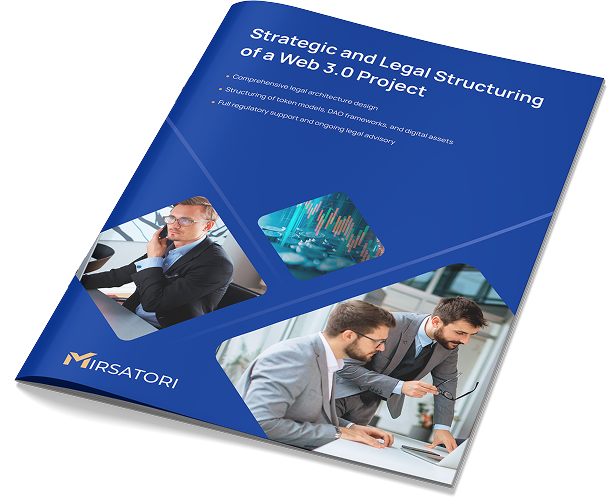
Calculate the budget for the legal structuring of your Web3 project

Mirsatori's team examines the reasons behind the rush of European HNWIs to Dubai, from low taxes, safety, business opportunities, and more. Below, we explore 5 of the most important and compelling...
According to Andris Kaushelis, General Manager of the international law firm Mirsatori, modern legal mechanisms allow you to build an asset ownership structure that only shares information with...
Spain is one of the few countries where the government has officially defined the term “innovation” and incorporated it into Law 28/2022, “On the Development of the Startup Ecosystem.”
It depends on the protocol’s functionality. If the protocol interacts with fiat currency, holds user assets, or provides investment advice, the answer is likely yes. Regulators assess the activity based on its actual substance, not its label.
In theory, yes — but in practice, achieving a sufficient level of decentralization is difficult. Regulators focus on those who derive economic benefit from the protocol: founders, governance token holders, and contributors with access to key functions.
There is no universal answer. The choice depends on the type of project, target markets, tax objectives, and reputational requirements.
From several thousand to several hundred thousand U.S. dollars, depending on the complexity of the structure and the number of jurisdictions involved.
From 3 to 12 months, depending on the jurisdictions and license types. Company incorporation and a legal wrapper for a DAO usually take 4–8 weeks. Obtaining a VASP license in the UAE typically takes 3–6 months, and in Switzerland 6–12 months. Parallel work across multiple jurisdictions may shorten the overall timeline.
Yes, but with limitations. A VASP license may cover crypto-asset operations, but some jurisdictions (including the U.S. and the EU) may require additional licenses or registrations. It is also important to consider sanctions regimes and marketing restrictions in target countries.
Schedule a meeting with our specialists, in-office or online, and receive a tailored case analysis, a clear cost estimate, and the best solution to achieve your goals.

Fill out the form to schedule a meeting in the office or online

Unlock your options — consult with an expert today
 +971 58 94 43 591